
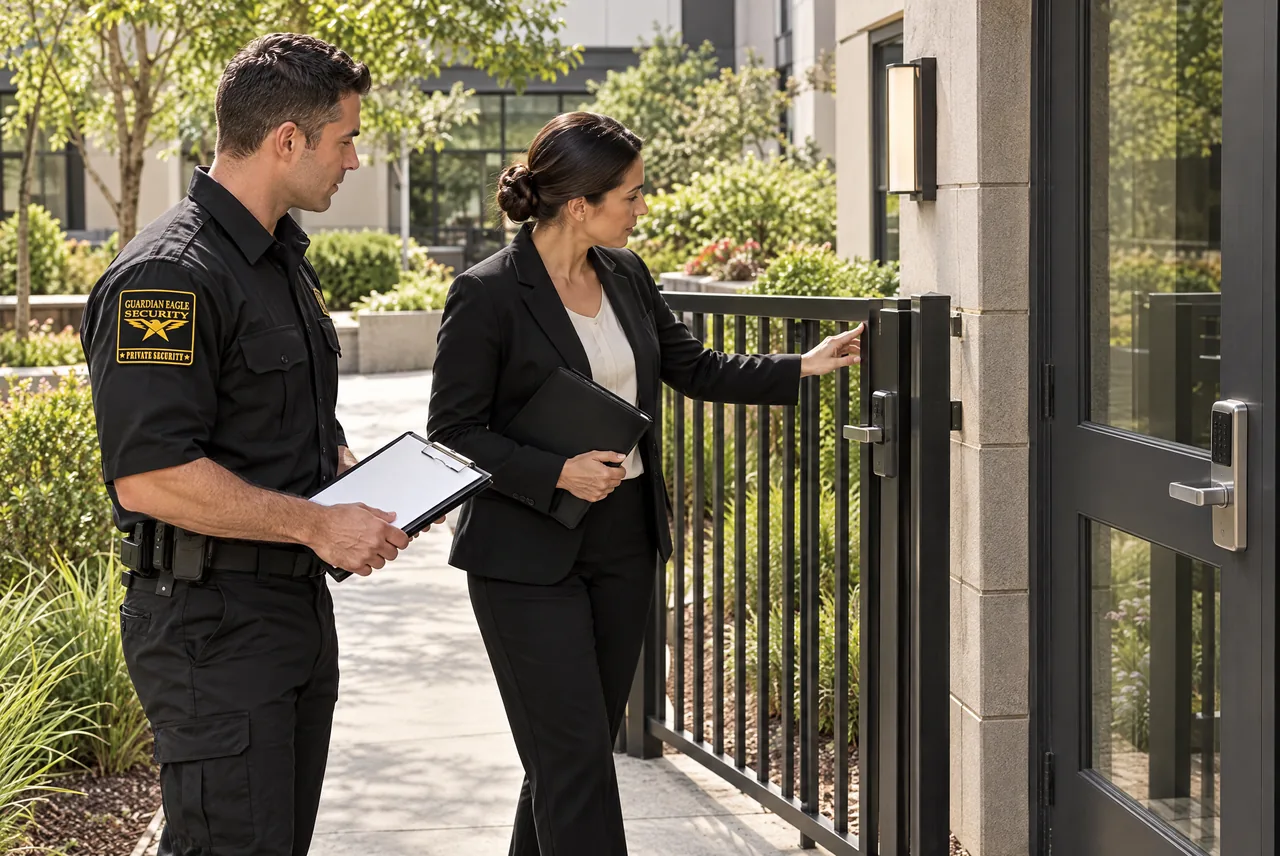
AI-generated illustration created for Guardian Eagle Security, Inc.
For a business owner or property manager, avoiding security mistakes starts with a clear plan for people, access and follow-up. Cameras, locks and alarms can support that plan, but they do not decide who should respond when an issue is reported. Use the checklist below when reviewing guard coverage for a commercial building, apartment community or other property in Los Angeles County.
1. Buying coverage without defining the assignment
A proposal that only lists a guard and a number of hours leaves important questions unanswered. Identify the areas to be covered, the tasks expected during each shift and the person who can authorize changes. A lobby post, a parking-area patrol and an overnight property check serve different purposes.
Ask for written post orders that describe the agreed duties, communication process and reporting expectations. If your building needs a staffed entrance and patrol coverage at the same time, discuss how those duties can be covered without leaving a required post unattended.
Use a property-specific brief: construction site security should address changing gates and contractor access; shopping center security should distinguish shared-area duties from tenant responsibilities. Where fire-protection-system impairments call for dedicated fire watch security, define that watch separately so general patrol work does not interrupt its required rounds and notifications.
2. Using the same plan at every hour
Review how the property changes between business hours, evenings and weekends. Visitor access, deliveries, contractor work and resident activity may create different needs. Match the proposed schedule to those needs instead of assuming that one shift pattern suits every property.
Confirm how shift handovers, absences and changes in coverage will be handled. For an ongoing contract, identify who reviews the schedule and how the client can raise a concern.
3. Treating cameras and locks as a complete response plan
Check that doors, lighting and access equipment work, and assign maintenance issues to the appropriate property contact. Then establish how guards and management will communicate when something needs attention. An observation, an incident report and an emergency response are different tasks; the instructions should make those distinctions clear.
4. Collecting reports without reviewing them
Decide which routine activities and incidents should be documented, who receives the reports and when the client and security provider will review recurring issues. Reports should help management take action, such as arranging a repair or revising an access procedure.
Guardian Eagle Security, Inc. uses TrackTik for reporting and supervision, including photographs and geofencing. Discuss the reporting features and supervisor communication that will be included in your assignment rather than assuming every contract has identical deliverables.
5. Choosing a provider on the hourly rate alone
Compare proposals using the same scope: staffing hours, post duties, supervision, reporting and the process for requesting changes. Ask what is included, what would require a separate agreement and how coverage concerns are escalated. A clear scope makes the offers easier to compare and the service easier to review.
Prepare a useful security-service inquiry
Have your property location or ZIP code, property type, desired start date, coverage hours and expected contract duration ready. Describe the operational concern without sharing confidential access codes or detailed security procedures in a public inquiry.
Explore our commercial security guard services or apartment and HOA guard coverage, then request a security proposal for your property. Assignment details and availability are confirmed during the proposal process.
When reviewing these gaps with a licensed security company in Los Angeles, turn each concern into a duty, a schedule and a named decision maker. Ask the provider to identify any tasks that cannot be performed simultaneously by one officer.