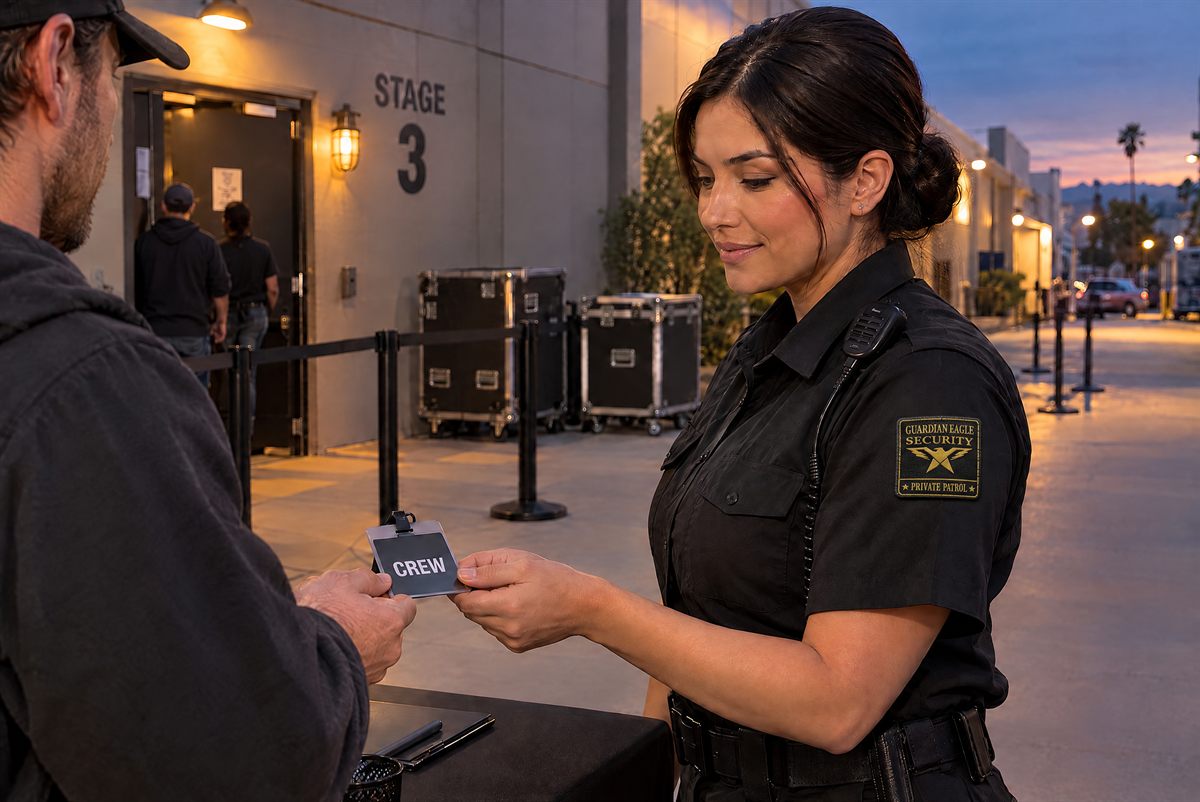
Build coverage around the run of show
01 / BEFORE OPENING
Know who is arriving to work
During load-in, crews, vendors and equipment may use a different entrance from guests. Give the assigned officer a named production or venue contact, the approved access window and the process for an unexpected arrival. Define the areas included in the assignment before personnel start moving between them.
02 / DURING OPERATION
Keep admission and restricted access distinct
Ticket or guest-list checks, queue observation and backstage access are separate tasks. Establish who resolves a ticket issue and who approves entry behind the public area. Crowd-management duties should fit the venue’s operating plan, with accessible routes and exits kept clear.
03 / AFTER CLOSING
Cover the last departure
Audience exit is not always the end of the job. Describe the vendor collection window, equipment movement and final authorized occupants. Agree who confirms that restricted rooms and service entrances are ready for handover to property management.
The change between scenes
Plan for the moment two activities overlap
A screening can finish while another audience queues. A production can wrap while equipment vendors arrive. Those overlaps deserve their own staffing discussion because a single entrance officer may be asked to handle unrelated decisions at once.
Mark the overlap on the run of show, then assign ownership of admission, restricted access and vendor check-out. Give each post a communication contact who can resolve an issue without pulling the officer away from the assigned area. Revise the briefing when the production schedule changes, rather than expecting the team to infer a new plan on site.
Hollywood geography matters at the entrance
The Hollywood Boulevard entertainment corridor includes the Walk of Fame and Hollywood & Highland area in 90028. A venue’s public address may differ from its loading or crew entrance. Include both approaches in the site plan, especially for arrivals from the US-101 corridor or properties with access on a side street.
Landmarks help locate an inquiry; the deployment is designed for your venue. We do not assume that a security assignment includes neighboring sidewalks, other businesses or public-road traffic control. Identify the property boundary and any coordination responsibilities before staffing is agreed.
When entertainment and residential access share a block
A mixed-use property can have evening customers at ground level and residents coming home through a nearby lobby. Separate those routes in the guard instructions. Explain which entrance remains available to residents, how guests are confirmed and where venue visitors should be directed.
For a recurring property contract, our commercial security guard services cover the broader business scope. Where apartments or an HOA share the site, use the residential security guide to define common-area and guest procedures.
Make the closeout useful to the next team
TrackTik geofencing and photo reporting support Guardian Eagle’s supervision and documentation. A Hollywood assignment can specify checkpoints at approved entrances, condition photos of service doors and a record of outstanding issues at wrap. Photography rules should respect production confidentiality and avoid capturing restricted materials or private guest information.
A helpful closeout distinguishes a completed check from a problem that still needs an owner. Identify the location, time, observed condition and responsible venue contact. Agree in advance which situations require a call while the event is running.
Does a production request automatically include studio access?
No. Facility access and required credentials depend on the specific location. Provide the production’s requirements so the team can review qualifications and staffing before confirming service.
What information makes an event proposal more accurate?
Include dates, estimated attendance, load-in and load-out times, entrances, restricted areas and the venue contact. Separate ticketing responsibilities from security duties, and identify any overnight period when equipment remains on site.
Share the run of show, not just the event time
Send the venue, estimated attendance, crew access window and final load-out time. Identify backstage or production areas that need separate access control. We will review the full operating period when discussing personnel and duties.
Sales: 8 a.m.–10 p.m. daily, Pacific · Verify California PPO 14773
LA County service areas · Careers
Local reference resources
Hollywood Entertainment DistrictHollywood & Highland locationHollywood US-101 corridor